
If you’ve ever stood in front of your fridge wondering whether a Turkey Hummus Wrap for diabetics can actually fit into your blood-sugar goals, you’re not alone. Most of us who’ve tried to balance convenience with glucose control have had that moment of hesitation – the quiet little voice asking, “Is a wrap going to spike me?” And honestly, I’ve been there. It’s one of those everyday food dilemmas that feels small until it suddenly isn’t.
But here’s the thing: wraps aren’t the enemy. Not by default, anyway. What tends to trip people up isn’t the idea of a wrap – it’s the type of tortilla, the way the ingredients are layered, and how the protein–fiber balance plays out. When you get those pieces right, a hummus wrap can actually become one of those rare diabetes-friendly lunches that feels satisfying, fast, and stable. And that’s really the north star here: stability. The feeling of eating something you enjoy without the after-meal guessing game.
That’s partly why this recipe exists. Most diabetic-friendly meals online are either painfully bland or so over-engineered they feel like a science project. But this wrap – whether you choose turkey, chicken, or a vegetarian swap – hits that middle ground most of us actually live in. Quick. Tasty. Familiar. No complicated techniques, no obscure ingredients. Just balanced choices that quietly support you instead of sabotaging you.
We’ll walk through the why and how. Why high-fiber tortillas matter more than you think. How hummus anchors the wrap with plant-based fats that slow down glucose absorption. How to roll it so everything stays put (because, BTW, soggy wraps are the silent killer of lunch motivation). And we’ll explore variations – low-carb tortillas, vegetarian versions, and little tweaks that subtly shift the glycemic impact without changing the spirit of the meal.
By the time you’re done here, you’ll have a wrap that feels like something you want to eat, not something you’re settling for. And maybe, in the background, you’ll notice something else – a small easing of that everyday tension around food choices. Not perfection. Just progress.
Before we dive in, take a breath. This isn’t another list of diabetic restrictions. It’s a small everyday solution designed to make lunch a little easier, a little more predictable and a lot more enjoyable.
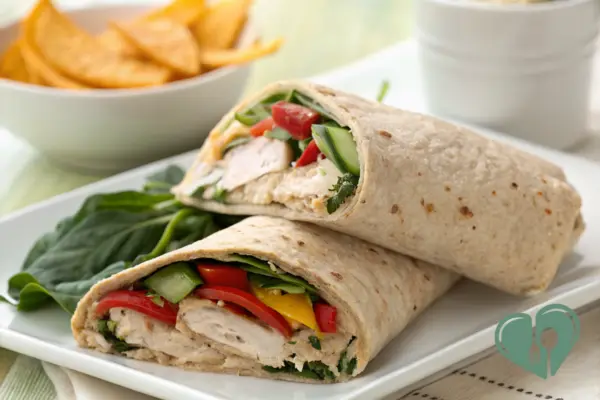
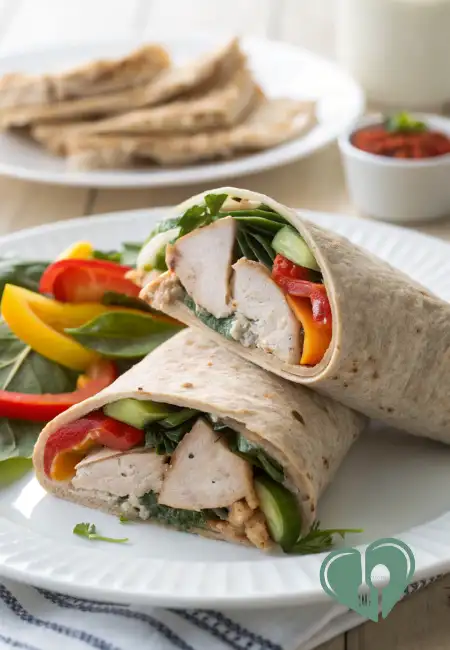

Turkey (or Chicken) Hummus Wrap
Ingredients
Equipment
Method
- Warm the tortilla for 5–10 seconds in the microwave or a dry skillet until flexible.
- Spread the hummus evenly over the tortilla, leaving a small border around the edges.
- Place the turkey or chicken slices in a horizontal line across the center of the tortilla.
- Add the spinach, cucumber, bell pepper strips, and any optional veggies on top of the protein.
- Fold the sides in slightly, then roll the tortilla tightly from the bottom up to form a wrap.
- Slice in half if serving immediately, or keep whole if packing for later.
Notes
- For better blood-sugar control, choose a high-fiber or low-carb tortilla. This makes the biggest difference in how the wrap digests.
- Pat tomatoes dry and keep wetter ingredients away from the edges to prevent sogginess, especially if meal-prepping.
- Turkey, chicken, tofu, or hard-boiled eggs all work well – aim for 3–4 oz protein to keep the wrap filling and balanced.
- Warm the tortilla briefly before rolling; it becomes more flexible and much easier to wrap tightly.
- Add extra veggies like spinach, peppers, or cabbage to increase fiber without adding many carbs.
- For a vegetarian version, swap the meat for tofu or add extra hummus for creaminess and steady energy.
Ingredients
It’s funny how something as simple as a wrap can feel complicated when you’re trying to keep blood sugar steady. The trick, at least from what I’ve noticed cooking for people who juggle diabetes every day, is that the ingredients matter way more than the recipe itself. Think of this list not like a set of rules, but more like a handful of choices that shape how your body handles the meal – little nudges in the right direction.
And honestly choosing ingredients becomes a lot less intimidating once you understand what each one actually does for you.
Lean Protein Options (Turkey, Chicken, or a Twist)
Go for a protein that feels clean and simple. Something that doesn’t fight with the hummus or overload the wrap.
- Sliced turkey breast
- Grilled or shredded chicken breast
- Leftover roasted chicken (just peel off most of the skin)
- Tofu strips if you’re leaning plant-based
- Even a sliced hard-boiled egg works surprisingly well
Aim for that sweet spot: enough protein to steady things, not so much that your tortilla looks like it’s holding on for its life.
Veggies (The Quiet Blood-Sugar Helpers)
Veggies aren’t just there to make you feel healthy; they’re the texture and fiber that help slow things down – digestion, glucose release, all of it.
Pick a mix you’ll actually enjoy biting into:
- Spinach or mixed greens
- Cucumber slices
- A handful of shredded carrots
- Bell peppers for color and crunch
- A couple of tomato slices (pat them dry)
- Purple cabbage if you want more fiber without trying hard
If you’ve ever had a wrap collapse into mush, you’ll appreciate that firmer veggies add structure.
Hummus (The Creamy Glue That Holds Everything Together)
Just a spoonful or two – that’s all you need. It adds flavor, healthy fat, and honestly, it keeps the entire wrap from falling apart in your hands. Any variety works as long as it’s not sweetened.
The Tortilla (Yes, It Matters More Than Anything Else)
You don’t need a lecture here – just a reminder that the tortilla can make or break the blood-sugar equation. Whole-grain, high-fiber, or low-carb tortillas are almost always the safer bet. For more high-fiber sandwich and wrap ideas, see Diabetes-Friendly Sandwiches and Wraps High in Fiber.
Quick Question – “Can I throw in cheese?”
If it makes the wrap feel more satisfying, sure. Just keep it light. A thin slice of mozzarella, Swiss or even a sprinkle of feta isn’t going to derail anything.
Steps to Make Your Turkey (or Chicken) Hummus Wrap
There’s something oddly comforting about assembling a wrap – almost like your brain gets a moment to slow down while your hands take over. And if you’ve ever made one that fell apart halfway through eating it (we all have), you start to appreciate the tiny choices that make a wrap actually behave. These steps aren’t meant to be rigid… just gentle guidance from someone who’s ruined enough wraps to know what not to do.
Step 1: Warm the Tortilla Just a Little
If there’s one step people skip – and regret – it’s this one. A cold tortilla behaves like it has opinions. It cracks, it resists, and it absolutely refuses to roll neatly. Just warm it for a few seconds until it’s flexible. Not hot. Not stiff. Just… cooperative.
Place it on the counter and let it sit for a moment. You’ll feel when it’s ready.
Step 2: Spread the Hummus (And Resist the Urge to Go Right to the Edge)
Add a spoonful of hummus in the center and gently drag it outward. Leave a border. Trust me – covering the whole surface feels “complete,” but it’s the fastest path to hummus squeezing out the sides when you take your first bite.
Spread & Layer
Think of hummus like the quiet foundation of the whole wrap. Where it sits, everything else tends to stay put. And because it’s rich in those slow-digesting fats it quietly keeps your blood sugar steadier than you might expect.
Step 3: Lay Down the Protein
This part is easy: line your turkey or chicken horizontally across the middle. Not piled high, not pushed to one side – just a calm, even layer. If you ever rolled a burrito in college, this is basically the same instinct. But here, less is more. About 3–4 ounces is the sweet spot.
Step 4: Add the Veggies Without Overthinking It
This is where people tend to panic and throw in everything they own. But you don’t need a mountain of vegetables for it to feel fresh and balanced. A few slices of cucumber, some greens, maybe a crunchier veggie like peppers or cabbage – that’s enough. The goal isn’t to stuff it full; it’s to build something that holds together when you actually eat it.
And honestly, the whole wrap just tastes better when it isn’t fighting gravity.
Step 5: Roll the Wrap Like You Mean It
There’s a tiny moment of commitment here: once you start rolling, you just… go. No hesitation.
Rolling Technique
- Fold the sides in a little – like tucking in elbows.
- Bring the bottom edge up and over everything.
- Keep it snug, not tight.
- Roll forward until the seam lands underneath and stays put.
If you get to the end and nothing falls out, you’ve done it right. And if a piece of cucumber shoots out the side? Welcome to the club.
Step 6: Slice or Don’t – It’s Your Call
Cutting it diagonally does make it look like something you’d get from a café, but if you’re packing it for later, leaving it whole keeps everything neater. Either way, the wrap doesn’t judge you.
Quick FAQ – “Why does my wrap get soggy?”
Moisture is the enemy here. Dry your veggies go lighter on tomatoes, and if you’re meal-prepping, wrap it in parchment instead of plastic. Parchment absorbs. Plastic traps. It’s a small difference that turns into a big one hours later.
Why Wraps Can Work for Diabetes
If you’ve ever sworn off wraps because they “must be bad for blood sugar,” you’re definitely not alone. A lot of people living with diabetes have this automatic suspicion of anything that even looks like bread. And honestly? I get it. We’ve all had that one wrap – usually a giant white-flour tortilla with more carbs than a whole plate of pasta – that sent blood sugar on a roller coaster. So the idea that wraps can actually work for diabetes feels counterintuitive at first.
But here’s where it gets interesting: it’s not the concept of a wrap that’s the problem. It’s the ratio – carbs to protein, fiber to filling, and, honestly, size to… well, human appetite. When those things shift even slightly, a wrap goes from “blood-sugar gamble” to “balanced and predictable lunch.” And predictable is really what most diabetics want, right? Not perfection – just fewer surprises. For a deeper dive into fiber-focused, diabetes-friendly lunch ideas, see The Ultimate Guide to High-Fiber Diabetes-Friendly Lunches.
The heart of this is something deceptively simple: fiber and structure. A good high-fiber tortilla paired with lean protein and hummus slows down digestion enough that the carbs don’t hit your bloodstream all at once. There’s this idea floating around online that all wraps are high-GI, but that’s only true if you grab the big white flour kind that practically melt in your hand. Whole-grain or low-carb wraps behave differently. They digest more like beans or lentils – gradually, almost politely. And that shift in pacing makes a world of difference.
There’s also a psychological layer people don’t talk about much: eating a wrap feels normal. It doesn’t scream “diet food” or “restricted diabetic meal,” and sometimes that sense of normalcy reduces the fatigue that comes with constantly thinking about blood sugar. Food that feels familiar tends to be easier to sustain – and sustainability, not strictness, is what supports long-term blood-sugar stability.
Now, the caveat: wraps can still spike you if the tortilla is too big, the filling too light, or the hummus portion turns into a full-on spread-fest. That’s why choosing the right tortilla matters more than almost anything else. Not to sound dramatic but the tortilla is the quiet decision that determines how the whole meal behaves.
Choosing the Right Tortilla
If the wrap is the story, the tortilla is the plot twist. The right one can steady your blood sugar; the wrong one can undo all your good intentions.
Here’s the quick mental checklist I use – nothing scientific, just deeply practical:
- Whole-grain first. More fiber, slower digestion.
- Low-carb or high-fiber tortillas if you need tighter carb control.
- Watch the diameter. Those giant burrito tortillas can have 30–50 grams of carbs before you add a thing.
- The “bend test.” Softer, flexible tortillas are usually made with better fiber blends.
- Sodium check. Some low-carb tortillas sneak in a ton of salt. Worth glancing at the label.
And if you’re wondering whether a wrap ever becomes “too healthy” to actually taste good – yes, sometimes. Some ultra low-carb tortillas feel like edible cardboard. You’ll know immediately. The trick is finding that middle ground where the nutritional profile supports you and you actually want to eat it.
Quick FAQ – “Do wraps have a lower glycemic index than bread?”
Often yes when you choose whole-grain or high-fiber tortillas. Wraps with more fiber and fewer refined flours tend to digest slower than soft white bread which can help keep blood sugar steadier. But GI varies, so reading the label matters more than the format.
Variations to Keep Your Diabetes-Friendly Wrap Interesting
One thing I’ve noticed, especially talking with people who manage diabetes every day, is how quickly meals can start to feel repetitive. You find a lunch that “works” – something predictable, something safe – and then suddenly you’re eating it three times a week until you’re sick of it. It’s not that the food is bad. It’s that sameness has a way of wearing you down.
That’s why building variations into a simple wrap like this matters more than it seems. You’re not just switching ingredients; you’re keeping yourself out of that burnout loop where every lunch becomes a decision fatigue moment. These versions keep the spirit of the wrap intact – portable, satisfying, not complicated – but give you enough wiggle room to stay interested.
Low-Carb Tortilla Options (When You Need Tighter Control)
Let’s be honest: low-carb tortillas are a bit of a mixed bag. Some are fantastic – soft, flexible, high in fiber. Others taste like someone flattened a sponge and called it a day. You’ll know which is which immediately. That said they can be incredibly helpful if you’re trying to keep carbs low without giving up the idea of a wrap.
Here are a few categories that consistently work better:
- High-fiber whole-wheat tortillas
These usually land in the “middle ground” – not ultra low-carb, but much slower on digestion. - Low-carb flour blends
Brands using oat fiber, flaxseed, or psyllium often behave better and taste more like a normal tortilla. - Almond-flour tortillas
These are grain-free and surprisingly gentle on blood sugar, though they can be more delicate to roll. - Protein tortillas
Some use egg whites or whey as the main base. The flavors vary, but they’re worth trying if you need extra protein.
If you ever warm a tortilla and it still cracks when you bend it that’s usually a sign it’s too dry or too “diet-y” to enjoy. Give yourself permission to choose taste over extreme carb cutting – long-term sustainability matters more than chasing the lowest number.
Vegetarian Version (A Whole Different Kind of Satisfying)
A lot of people assume a vegetarian wrap will be less filling, but honestly, sometimes the plant-based version tastes even better. Hummus already leans in that direction creamy, savory, naturally stabilizing – so the rest just falls into place. For another delicious plant-based option, try our Grilled Veggie Hummus Wrap (Diabetic-Safe Lunch).
Here are a few ways to build a vegetarian wrap that still feels grounded and satisfying:
- Tofu strips, pan-seared or even cold
- Tempeh, sliced thin so it doesn’t overpower the wrap
- Hard-boiled eggs, for a sort of “Mediterranean egg salad without the mess” feel
- Extra hummus, if you want the wrap to have that rich, creamy vibe
And if you really want to push the fiber adding a bit of roasted chickpeas gives it this unexpected crunch that honestly feels a little addictive. For another simple, fiber-packed plant-based lunch, check out our Veggie and Hummus Sandwich for Diabetics (High-Fiber Lunch Recipe)]
The surprise here is how hearty the vegetarian version feels. You might expect it to be lighter, but the healthy fats and plant protein often make it more filling than turkey or chicken.
Quick FAQ – “Can I make this gluten-free?”
Absolutely. Just choose gluten-free tortillas made from almond flour, cassava, or chickpea flour. The almond-flour ones usually have the gentlest impact on blood sugar, while cassava tends to be softer and more bread-like. Chickpea wraps are higher-carb but offer a ton of fiber, so they can still be a good fit depending on your goals.
Nutrition Information
It’s always tricky giving exact numbers for a wrap because every tortilla brand and protein choice shifts things a little. But here’s a realistic snapshot of what this turkey (or chicken) hummus wrap usually lands at – not perfect, but close enough to help you plan.
Most balanced diabetic-friendly versions fall roughly within:
- Calories: 320–420 per wrap
- Carbs: 22–32g (mostly depending on the tortilla)
- Fiber: 8–14g
- Protein: 20–30g
- Fat: 9–14g (mostly from hummus, not the problematic kind)
If you choose a low-carb or high-fiber tortilla, your carb count drops noticeably – sometimes by 8–12 grams – and the fiber jumps, which is where a lot of the blood-sugar stability comes from. A whole-grain tortilla gives you a slower, gentler digestion curve; an almond-flour one can be even easier on blood sugar, though it tastes slightly different.
Hummus adds a small amount of healthy fat and protein, but it’s the steadying effect – slowing the carbohydrate absorption – that matters more than the exact numbers. Lean proteins help the wrap feel grounding, which usually means fewer cravings later.
If you’re watching sodium, just glance at the tortilla label. Some low-carb ones sneak in more salt than you’d expect. A quick check goes a long way.
FAQs
Is hummus actually good for diabetics?
Yes – in most cases, it’s a quiet hero. Hummus is made from chickpeas, which digest slowly, and the healthy fats in it help soften the blood-sugar rise from the tortilla. It’s not magic but it’s one of those foods that consistently behaves predictably for a lot of people. Just watch flavored versions; some add unnecessary sugar.
Are wraps better than sandwiches for blood sugar?
They can be especially if you choose a high-fiber tortilla. Most sliced breads are low-fiber and hit faster, while a good tortilla (whole-grain, low-carb, almond-flour, etc.) slows digestion a bit. But this isn’t a one-size-fits-all thing it’s more about the specific bread or tortilla you pick.
How do I keep a wrap from spiking my blood sugar?
Think balance:
- High-fiber tortilla
- 3–4 oz lean protein
- A thin layer of hummus
- Veggies for volume and fiber
Portion size matters more than people admit. A giant burrito-sized tortilla will spike most people, no matter what you put inside it.
Can I meal-prep this wrap?
Yes – with one small tweak. Keep the wetter ingredients away from the edges, pat tomatoes dry and wrap the whole thing in parchment instead of plastic. Parchment breathes. Plastic traps moisture and gives you the dreaded soggy wrap the next day.
What’s the best tortilla for diabetics?
Short version: high fiber = slower rise. Look for:
- Whole-grain tortillas with 6g+ fiber
- Low-carb tortillas with oat fiber, flax, or psyllium
- Almond-flour tortillas for a grain-free option
If a tortilla cracks even after warming, it’s usually too dry or too artificially “diet” to be enjoyable.
Can I skip the tortilla and make this a bowl?
Absolutely. Just layer everything in a bowl and add a little extra hummus or a splash of lemon to tie it together. It’s simpler lower-carb and honestly, easier to eat if you’re home.
Conclusion: Turkey (or Chicken) Hummus Wrap for Diabetics
At the end of the day, this wrap isn’t meant to be complicated – it’s meant to be something you can rely on. A simple mix of lean protein, fiber-rich veggies, hummus, and the right tortilla can give you a meal that feels both familiar and steady, without the blood-sugar guesswork that sometimes sneaks in.
If you let it, this Turkey (or Chicken) Hummus Wrap for diabetics can become one of those easy go-to lunches you don’t have to overthink – the kind that fits into real life, not just a perfect day. Try it your way, tweak it as you go, and keep it effortless. That’s the part that makes it stick.

Dreena shares balanced, diabetes-friendly recipes made for real life—simple, nourishing, and full of flavor. Her kitchen is where health meets heart.